
Getting started
On Monday your friend Jamie told you:
"I'm going to the dentist tomorrow. I'm really nervous."
On Wednesday you tell another friend about it:
Jamie said he was going to the dentist the next day. He said he was really nervous.
Two things have changed: the tenses (am going → was going, am → was) and the time expression (tomorrow → the next day). The words were spoken in the past and the situation is different now, so you move everything one step back. This is called backshift.
Auf Deutsch: Backshift heißt Zeitverschiebung. Steht das einleitende Verb in der Vergangenheit (said, told), rückt die Zeitform in der indirekten Rede meist eine Stufe in die Vergangenheit.
Explanation
The backshift of tenses
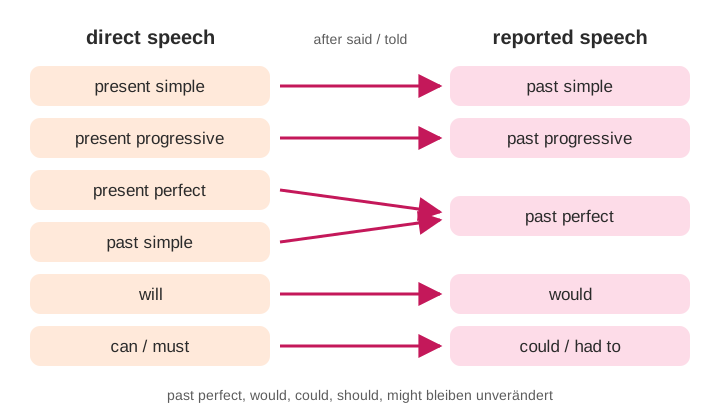
| direct speech | reported speech |
|---|---|
| present simple: "I like pizza." | past simple: He said he liked pizza. |
| present progressive: "I am working." | past progressive: She said she was working. |
| present perfect: "I have finished." | past perfect: He said he had finished. |
| past simple: "I saw the film." | past perfect: She said she had seen the film. |
| will: "I will help you." | would: He said he would help me. |
| can: "I can swim." | could: She said she could swim. |
| must: "I must go." | had to: He said he had to go. |
Some forms do not change: would, could, should, might and the past perfect stay the same.
When there is no backshift
You can keep the tense when the statement is still true now:
- "Berlin is the capital of Germany." → Our teacher said Berlin is the capital of Germany.
- "I live in Hanover." → She said she lives in Hanover. (if she still lives there)
In tests, using the backshift is always correct. Keeping the tense is a choice when the fact is still true.
Time and place expressions
When you report later or in another place, words like today or here do not fit any more. They change too.
| direct speech | reported speech |
|---|---|
| today | that day |
| tonight | that night |
| tomorrow | the next day / the following day |
| yesterday | the day before / the previous day |
| next week | the following week |
| last week | the week before / the previous week |
| now | then / at that moment |
| ago | before |
| here | there |
| this / these | that / those |
Auf Deutsch: Diese Wörter ändern sich nur, wenn sich Zeit oder Ort wirklich geändert haben. Berichtest du am selben Tag, bleibt today stehen.
Examples
Example 1: An interview with a runner
The local newspaper interviewed a young runner after a race.
"I have trained for two years for this race. I ran 20 kilometres yesterday. Next year I will try the marathon."
Report in the newspaper the next week:
She said she had trained for two years for that race. She said she had run 20 kilometres the day before. She said that the following year she would try the marathon.
Example 2: Step by step
Direct speech: Mr Brown: "I can't come today because my car is broken."
- Pronouns: I → he, my → his.
- Tenses: can't → couldn't, is → was.
- Time: today → that day.
Reported speech: Mr Brown said he couldn't come that day because his car was broken.
Rule
After said or told: move the tense one step back (am → was, have done → had done, did → had done, will → would, can → could). Change time and place words if the time or place has changed (tomorrow → the next day, here → there). Change the pronouns.
Exercises
Grundlagen
- Backshift the verbs. a) is b) are playing c) has eaten d) went e) will come f) can see
- Report the sentences. Start with She said …. a) "I am tired." b) "I have lost my keys." c) "I will call you later."
Weiter
- Report the sentences. Change tenses, pronouns and time expressions. a) Tom: "I saw your brother yesterday." b) Mia: "We are having a party tonight." c) Mr Lee: "I can't help you now."
- Which sentence could keep its tense? Explain. a) "Water boils at 100 degrees." b) "I'm wearing a red jacket today." (said last month)
Knobeln
- A famous person visited your school last month and said: "I grew up in a small town. I have always loved music. I am working on a new album now. It will come out next year." Write a short report for the school newspaper.
Lösungen
- a) was b) were playing c) had eaten d) had gone e) would come f) could see
- a) She said she was tired. b) She said she had lost her keys. c) She said she would call me later.
- a) Tom said he had seen my brother the day before. b) Mia said they were having a party that night. c) Mr Lee said he couldn't help me then.
- a) It can keep the tense because it is a general fact that is still true: She said water boils at 100 degrees. b) It must change: He said he was wearing a red jacket that day. The situation is over.
- For example: Last month the singer Tilly Brackenford visited our school. She said he had grown up in a small town and that she had always loved music. She told us she was working on a new album at that time and that it would come out the following year. (Tilly Brackenford is an invented name.)