
Getting started
Compare these two sentences:
If I get a good mark in the test, I will buy myself a pizza.
If I got a good mark in the test, I would buy myself a pizza.
Both are correct. The grammar is different because the speaker's view is different. In the first sentence, the speaker thinks a good mark is quite possible. In the second, the speaker does not really expect it. This lesson shows you how to choose.
Auf Deutsch: Ob du Typ 1 oder Typ 2 wählst, hängt davon ab, wie wahrscheinlich du die Bedingung findest. Die Grammatik zeigt deine Einschätzung.
Explanation
How likely is it?
Think of a scale from real to impossible.
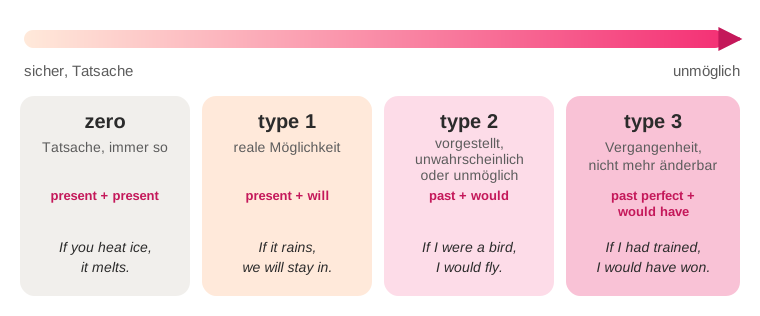
- Zero conditional: facts and things that always happen. If you heat ice, it melts. Both parts are in the simple present.
- Type 1: a real possibility in the present or future. If it rains tomorrow, we will stay at home.
- Type 2: an imagined, unlikely or impossible situation in the present or future. If I were a bird, I would fly to Australia.
Questions that help
- Is it a general fact or something that always happens? → zero conditional.
- Can it really happen, and do I think it is possible? → type 1.
- Is it a dream, a wish, a situation that is not true now, or very unlikely? → type 2.
Same situation, different views
Sometimes both types are possible. The choice shows what the speaker thinks:
- If Germany wins the World Cup, I'll celebrate all night. A fan who believes in the team.
- If Germany won the World Cup, I'd celebrate all night. A fan who does not expect it.
Auf Deutsch: Achte bei Typ 2 auf die Zeitform: Das simple past im if-Satz bedeutet hier nicht Vergangenheit, sondern „nicht wirklich“ oder „unwahrscheinlich“.
Checking your sentence
| if-clause | main clause | |
|---|---|---|
| zero | simple present | simple present |
| type 1 | simple present | will / can / imperative |
| type 2 | simple past | would / could / might |
Never put will or would in the if-clause.
Examples
Example 1: The class trip
Your class is discussing a trip at the end of the school year.
- If we collect enough money at the cake sale, we will go to Heide Park. The cake sale is next week. This is realistic.
- If we had more money, we could go to London. The class has only a small budget. London is a dream.
- If you buy a group ticket, it is cheaper. This is a general fact about group tickets.
Example 2: Two friends
Mia: If I finish my project tonight, I'll come to your party. Jonas: Great. And if you brought your guitar, we could play some songs. Mia: My guitar? If I took it on the bus, it would get damaged.
Mia thinks finishing the project is possible (type 1). Jonas makes a suggestion he is not sure about (type 2). Mia imagines the bus journey and its result (type 2).
Rule
Zero: fact, present + present. Type 1: real possibility, present + will. Type 2: imagined or unlikely, past + would. The type shows how likely the speaker thinks the condition is.
Exercises
Grundlagen
- Zero, type 1 or type 2? Name the type. a) If you mix blue and yellow, you get green. b) If I had wings, I would fly to school. c) If you lend me your bike, I'll give it back tomorrow.
- Put the verbs into the correct form. Decide which type fits. a) If I (see) a ghost, I (scream). (You don't believe in ghosts.) b) If the bus (be) late again, I (walk) to school. (The bus is often late.) c) Water (boil) if you (heat) it to 100 degrees.
Weiter
- Write two sentences for each situation, one type 1 and one type 2. Explain the difference. a) meet a famous footballer b) get a new phone for my birthday
- Correct the mistakes. a) If I would know the answer, I would tell you. b) If you will help me, I help you. c) If I had time tomorrow, I will come.
Knobeln
- Write a short dialogue (six lines) between two friends who are planning the weekend. Use at least two type 1 and two type 2 sentences.
Lösungen
- a) zero conditional (a fact) b) type 2 (impossible) c) type 1 (a real possibility)
- a) If I saw a ghost, I would scream. (type 2, you think it is impossible) b) If the bus is late again, I will walk to school. (type 1, it really can happen) c) Water boils if you heat it to 100 degrees. (zero conditional, a fact)
- For example: a) If I meet a famous footballer at the airport, I'll ask for a photo. (I am going to the airport, and the team is flying today.) / If I met a famous footballer, I would ask for a photo. (I don't expect it.) b) If I get a new phone for my birthday, I'll give you my old one. (My parents have almost promised it.) / If I got a new phone, I would give you my old one. (It's unlikely.)
- a) If I knew the answer, I would tell you. b) If you help me, I will help you. c) If I have time tomorrow, I will come. or If I had time tomorrow, I would come. (Both parts must be of the same type.)
- For example: A: If the weather is nice on Saturday, I'll go to the lake. B: Good idea. If I finish my homework on Friday, I'll come too. A: If we had a boat, we could go out on the water. B: If my uncle were here, he would lend us his canoe. A: Never mind. If it gets hot, we'll just swim. B: OK, if I'm late, I'll text you.