
Getting started
Compare these two sentences:
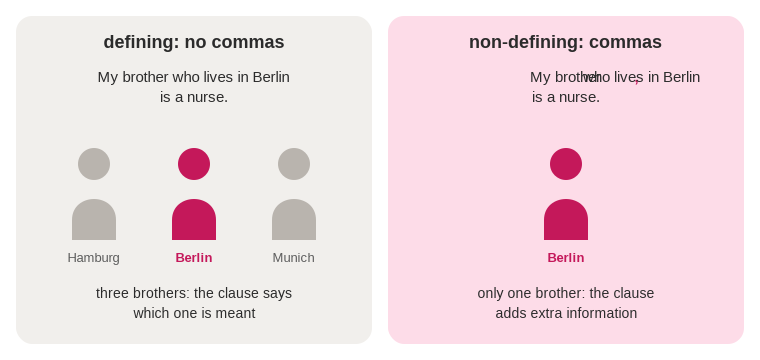
My brother who lives in Berlin is a nurse. My brother, who lives in Berlin, is a nurse.
They look almost the same. The only difference is two commas. But they don't mean the same thing. In the first sentence, the speaker has more than one brother and tells you which one is meant: the one in Berlin. In the second sentence, the speaker has only one brother. The part between the commas is just extra information.
Auf Deutsch: Im Englischen entscheiden die Kommas über die Bedeutung. Ohne Komma: notwendige Information (defining). Mit Kommas: Zusatzinformation (non-defining).
Explanation
Two kinds of relative clauses
| defining relative clause | non-defining relative clause | |
|---|---|---|
| job | says which person or thing you mean | gives extra information |
| can you leave it out? | no, the sentence would be unclear | yes, the main message stays clear |
| commas | no commas | commas before and after |
| pronouns | who, which, that, whose | who, which, whose (never that) |
| contact clause? | yes, if the pronoun is the object | no, the pronoun must stay |
When are relative clauses non-defining?
After names and after nouns that are already clear, a relative clause can only give extra information:
- Lionel Messi, who was born in Argentina, has won the World Cup.
- Düsseldorf, which is the capital of North Rhine-Westphalia, lies on the Rhine.
- My mum, whose job is very stressful, needs a holiday.
There is only one Düsseldorf, so the relative clause cannot tell you which Düsseldorf. It adds information.
No that, no contact clause
In non-defining relative clauses you can't use that, and you can't leave out the relative pronoun:
- wrong: Düsseldorf, that is the capital of NRW, lies on the Rhine.
- wrong: The Rhine, I crossed yesterday, is very long.
- right: The Rhine, which I crossed yesterday, is very long.
Where to put the commas
The relative clause comes directly after the noun. Put one comma before it and one after it. If the clause is at the end of the sentence, the full stop replaces the second comma:
Yesterday I met Tom, who was in my class in primary school.
Auf Deutsch: Im Deutschen steht immer ein Komma, auch bei notwendigen Relativsätzen. Prüfe im Englischen jedes Mal: Brauche ich den Relativsatz, um zu wissen, wer gemeint ist? Dann kein Komma.
Examples
Example 1: Defining or non-defining?
| sentence | type | why |
|---|---|---|
| The students who passed the test got a certificate. | defining | It tells you which students: only those who passed. |
| The students, who all passed the test, got a certificate. | non-defining | All students passed. The clause adds information. |
| Berlin, which is the capital of Germany, is also its largest city. | non-defining | There is only one Berlin. |
| The city where I was born is very small. | defining | It tells you which city. |
Example 2: Writing a short profile
Non-defining relative clauses help you to put a lot of information into a few sentences. Compare:
Malala Yousafzai was born in Pakistan. She campaigns for girls' education. She won the Nobel Peace Prize in 2014. She was only 17 at that time.
Malala Yousafzai, who was born in Pakistan, campaigns for girls' education. In 2014 she won the Nobel Peace Prize, which made her the youngest Nobel Prize winner in history.
The second text is shorter and connects the ideas. (The which in the last sentence refers to the whole fact that she won the prize. You will learn more about this in lesson 4.)
Rule
Non-defining relative clauses add extra information. They have commas, use who, which, whose (never that), and the relative pronoun can never be left out. Typical after names and unique nouns.
Exercises
Grundlagen
- Defining (D) or non-defining (N)? Add commas where necessary. a) The Thames which flows through London is about 346 km long. b) The boy who broke the window must pay for it. c) My mum who is 45 still plays tennis every week. d) The phone which I bought last week has stopped working.
- Correct the mistakes. a) Angela Merkel, that was Chancellor for 16 years, studied physics. b) Cologne, I visited last summer, is famous for its cathedral.
Weiter
- Join the sentences with a non-defining relative clause. a) Lisa is my best friend. She is moving to Hamburg. b) The Ruhr was once a big coal-mining area. It is now known for culture and industrial heritage. c) Mr Wilson teaches us English. His wife is from Australia. d) We went to Blackpool. We had never been there before.
- Explain the difference in meaning. a) The players who were tired went home. b) The players, who were tired, went home.
Knobeln
- Write a profile of a famous person (60 to 80 words) with at least three non-defining relative clauses.
- Translate. Decide each time: comma or no comma? a) Meine Schwester, die in Münster studiert, besucht uns am Wochenende. (You have one sister.) b) Das ist der Lehrer, der uns in Mathe unterrichtet. c) Münster, das für seine vielen Fahrräder bekannt ist, liegt im Norden von NRW.
Lösungen
- a) N: The Thames, which flows through London, is about 346 km long. b) D: no commas (only the boy who broke it) c) N: My mum, who is 45, still plays tennis every week. (you have only one mum, so her age is extra information) d) D: no commas (which phone? the one I bought last week)
- a) Angela Merkel, who was Chancellor for 16 years, studied physics. (no that in non-defining clauses) b) Cologne, which I visited last summer, is famous for its cathedral. (the pronoun can't be left out)
- a) Lisa, who is moving to Hamburg, is my best friend. (or: Lisa, who is my best friend, is moving to Hamburg.) b) The Ruhr, which was once a big coal-mining area, is now known for culture and industrial heritage. c) Mr Wilson, whose wife is from Australia, teaches us English. d) We went to Blackpool, where we had never been before.
- a) Only some players were tired, and only those went home. b) All the players were tired, and they all went home.
- Individual answers, for example: Lionel Messi, who was born in Rosario in Argentina, is one of the best footballers in history. He played for FC Barcelona, where he spent more than 15 years. In 2022 he won the World Cup with Argentina, which had been his biggest dream. Messi, whose family moved to Spain when he was 13, first played in Barcelona's youth teams.
- a) My sister, who studies in Münster, is visiting us at the weekend. (comma: extra information) b) This is the teacher who teaches us maths. (no comma: it says which teacher) c) Münster, which is famous for its many bikes, is in the north of NRW. (comma: there is only one Münster)