
Getting started
On a school trip to Essen you visit the Zollverein coal mine. A guide tells your group:
Coal was mined here for more than 130 years. The mine was closed in 1986. Today it is visited by thousands of tourists every year.
The guide does not say who mined the coal or who closed the mine. The workers and the mining company are not important here. The mine is the topic, so it comes first in each sentence. To do this, the guide uses the passive voice.
Auf Deutsch: Das Passiv (passive voice) stellt die Handlung oder das betroffene Ding in den Mittelpunkt, nicht die handelnde Person. Im Deutschen bildest du es mit „werden“: „Die Zeche wurde 1986 geschlossen.“
Explanation
Active and passive
Compare these two sentences:
- Active: Thousands of tourists visit the mine every year.
- Passive: The mine is visited by thousands of tourists every year.
Both sentences say the same thing. In the active sentence, the person who does the action (the agent, here thousands of tourists) is the subject. In the passive sentence, the thing that the action happens to (the mine) is the subject.
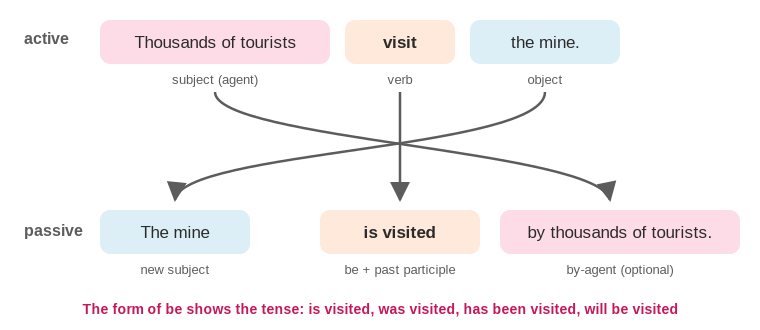
How to form the passive
The passive has two parts:
a form of be + past participle (3rd form of the verb)
The form of be shows the tense. The past participle never changes.
| tense | form of be | example |
|---|---|---|
| simple present | am / is / are | English is spoken in many countries. |
| simple past | was / were | The mine was closed in 1986. |
Regular verbs have past participles with -ed (closed, visited, invented). Many common verbs are irregular, so learn their 3rd form: build, built, built / write, wrote, written / speak, spoke, spoken / make, made, made / steal, stole, stolen.
Questions and negatives
The form of be does the work, just like in other sentences with be:
- Is English spoken in India? Yes, it is.
- The tickets were not (weren't) sold online.
The by-agent
If you want to say who did the action, add by + agent at the end:
The Harry Potter books were written by J. K. Rowling.
Often you leave the agent out, because it is unknown, unimportant or obvious:
- My bike was stolen yesterday. (You don't know who stole it.)
- Our school was built in 1975. (The builders are not important.)
Auf Deutsch: Achtung, falscher Freund: Das englische will bedeutet „wird“ nur im Sinne der Zukunft. Das deutsche Passiv-„wird“ heißt im Englischen is: „Das Fenster wird geöffnet.“ = The window is opened.
Examples
Example 1: From active to passive
Active: The caretaker locks the school gates at 6 p.m.
- Find the object: the school gates. It becomes the new subject.
- Find the tense: locks is simple present. The subject the gates is plural, so you need are.
- Past participle of lock: locked.
- Is the agent important? Not really, so leave it out.
Passive: The school gates are locked at 6 p.m.
Example 2: Facts from history
| active | passive |
|---|---|
| Alexander Fleming discovered penicillin in 1928. | Penicillin was discovered by Alexander Fleming in 1928. |
| Workers built the Eiffel Tower for the World's Fair of 1889. | The Eiffel Tower was built for the World's Fair of 1889. |
| People speak English and French in Canada. | English and French are spoken in Canada. |
In the first sentence, Fleming is important information, so the passive sentence keeps the by-agent. In the second and third sentences, workers and people say nothing new, so they disappear.
Rule
Passive = be + past participle. Simple present: am/is/are done. Simple past: was/were done. The object of the active sentence becomes the subject. Add by + agent only if it is important.
Exercises
Grundlagen
- Complete with the simple present passive. a) Football (play) in almost every country. b) The rooms (clean) every evening. c) Rice (grow) in many parts of Asia.
- Complete with the simple past passive. a) The first Harry Potter book (publish) in 1997. b) The windows (break) during the storm. c) The thief (catch) by the police.
Weiter
- Rewrite in the passive. Use a by-agent only where it is important. a) Someone cleans the classroom every day. b) Leonardo da Vinci painted the Mona Lisa. c) They made this film in Ireland. d) My grandmother wrote these letters.
- Make questions in the passive and answer them. a) your school / build / in the 1970s? b) English / speak / in Australia?
Knobeln
- Translate into English. Think about the tense first. a) Das Fenster wird jeden Morgen geöffnet. b) Die Zeche wurde 1986 geschlossen. c) Wurde dein Fahrrad gefunden?
- Write four passive sentences about your town or school, two in the simple present and two in the simple past. Example: The park is used by many families.
Lösungen
- a) is played b) are cleaned c) is grown
- a) was published b) were broken c) was caught
- a) The classroom is cleaned every day. (someone is not important, so no by-agent) b) The Mona Lisa was painted by Leonardo da Vinci. (the painter is important information) c) This film was made in Ireland. d) These letters were written by my grandmother.
- a) Was your school built in the 1970s? Yes, it was. / No, it wasn't. b) Is English spoken in Australia? Yes, it is.
- a) The window is opened every morning. (German „wird“ in the present = is, not will) b) The mine was closed in 1986. c) Was your bike found?
- Individual answers, for example: Our school is visited by many guests. The sports hall is used by local clubs. The library was opened in 2015. The old trees were cut down last year.