
Getting started
Your exchange partner Emily from Bristol is staying with your family in Dortmund. She wants to go to the swimming pool with you on Saturday and finds this notice on the pool's website:
Hallenbad Nord: Am Samstag, 14. März, ist das Bad wegen eines Schwimmwettkampfs nur von 15 bis 20 Uhr geöffnet. Das Sportbecken bleibt den ganzen Tag gesperrt. Der Saunabereich ist wie gewohnt geöffnet. Jugendliche bis 17 Jahre zahlen 3,50 Euro.
(Notice written for this course.)
Emily asks: What does it say? Can we go in the morning?
You don't need to translate every word. Emily wants to know if and when you can go swimming and how much it costs. The sauna is not interesting for her. What you are doing is called mediation.
Auf Deutsch: Sprachmittlung (mediation) heißt: Du gibst Informationen aus einer Sprache sinngemäß in einer anderen Sprache weiter, und zwar so, dass sie für eine bestimmte Person in einer bestimmten Situation nützlich sind. Es ist keine Übersetzung.
Explanation
Mediation is not translation
| translation | mediation |
|---|---|
| every word and sentence | only the information the other person needs |
| same structure as the original | your own structure and words |
| the original text decides | the person and the situation decide |
| no explanations | you can explain and add information if needed |
Four questions before you start
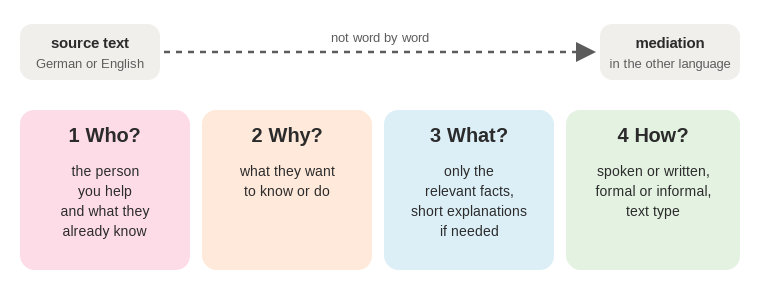
Before you mediate, answer these four questions:
- Who? Who is the person you are helping? A friend, a teacher, a tourist, your grandparents? Do they know anything about the topic?
- Why? What does the person want to know or do? (For example: decide if it is worth going, find the way, understand a rule.)
- What? Which information from the text is relevant for this person and this purpose? Everything else you leave out.
- How? Spoken or written? Formal or informal? Which text type do you need (chat message, email, short talk)?
Two directions
Mediation works in both directions:
- German → English: You help English-speaking people understand German information (a sign, a flyer, an announcement, a website).
- English → German: You help German-speaking people understand English information (a museum website, instructions, a message from a host family).
Don't translate word by word
Many German words and phrases have no direct English equivalent. Say what they mean:
- Hallenbad → indoor swimming pool
- Sportbecken gesperrt → the big pool for swimmers is closed
- wie gewohnt → you can leave it out or say as usual
Examples
Example 1: Emily and the swimming pool
Who? Emily, a friend, 15 years old. Why? She wants to go swimming on Saturday. What? Opening hours, the big pool, the price. How? Spoken, informal.
Sorry, we can't go in the morning. On Saturday there's a swimming competition, so the pool is only open from 3 to 8 p.m. The big pool for sports swimmers is closed all day, but we can use the other pools. It's 3.50 euros for us because we're under 18.
Notice what Emily does not get: the date (she knows it is Saturday), the name of the pool and the information about the sauna. Notice also what is added: so and but connect the facts, and because we're under 18 explains the price.
Example 2: The same text for another person
Your English grandmother, who loves the sauna, is visiting too. She asks: Can I relax a bit at the pool on Saturday?
Yes, the sauna is open as usual on Saturday. But the swimming pool is only open in the afternoon, from 3 to 8, because of a competition.
Same text, different person, different purpose, so the mediation is different.
Rule
Mediation: pass on the relevant information in the other language, sinngemäß (not word by word), adapted to the person and the situation. Ask first: Who? Why? What? How?
Exercises
Grundlagen
- Mediation or translation? Decide and explain. a) You tell a tourist in English what the German sign on the museum door says about opening hours. b) You write down every sentence of a German poem in English. c) You tell your parents in German what the English hotel email says about breakfast times.
- Explain in English what these German words mean. Don't translate word by word. a) Hallenbad b) Ferienwohnung c) Jugendherberge
Weiter
- Read the notice about the pool again. Your exchange partner Jack wants to go swimming early on Saturday and then go into town. Write what you tell him (3 to 4 sentences).
- Here is a German message from your sports club. Your Canadian guest wants to come to training with you. Pass on the relevant information in English.
Training am Mittwoch fällt aus, weil die Halle renoviert wird. Ersatztermin: Donnerstag, 17:30 Uhr, Turnhalle der Gesamtschule. Gäste sind willkommen, bitte Hallenschuhe mitbringen.
Knobeln
- Choose a short German text from your everyday life (a sign, a menu, a message). Write two mediations in English for two different people with different purposes. Explain which information you left out and why.
Lösungen
- a) Mediation: only the relevant information (opening hours), for a tourist. b) Translation: every sentence is kept. c) Mediation: only the breakfast times, for your parents.
- For example: a) an indoor swimming pool b) a holiday flat that you can rent c) a cheap hostel for young people and school groups
- For example: Sorry, we can't go in the morning. The pool is only open from 3 to 8 p.m. on Saturday because there is a competition. We could go into town first and go swimming in the afternoon.
- For example: There's no training on Wednesday because the sports hall is being renovated. Instead, we have training on Thursday at 5.30 p.m. in the gym of the comprehensive school. Guests are welcome, so you can come with me. You just need indoor sports shoes.
- Individual answers. Check: Is the information relevant for each person? Is the register right (informal for friends, more polite for adults)?