
Getting started
A typical cartoon task in a test has three parts:
- Describe the cartoon.
- Analyse the means the cartoonist uses to convey the message.
- Comment on the cartoon. (or: Do you agree with the cartoonist's view?)
You know how to do the first two. In this lesson you learn the third step, the comment, and then you put everything together with a new cartoon.
Auf Deutsch: Im Kommentar (comment) nimmst du Stellung: Ist die Aussage des Cartoons überzeugend? Stimmt sie mit deiner Erfahrung überein? Du begründest deine Meinung mit Argumenten und Beispielen, wie in einem kurzen comment.
Explanation
What a comment on a cartoon contains
- Your position: Do you agree with the message? Completely, partly or not at all?
- Arguments: Why? Use examples from your own life, from the news or from what you have learned.
- Evaluation of the cartoon (optional): Is it effective? Is the exaggeration fair or too extreme?
- Conclusion: Sum up your view in one or two sentences.
Useful language
- I (fully / partly) agree with the cartoonist because …
- In my opinion, the cartoon shows a real problem, as …
- On the one hand … On the other hand …
- A good example of this is …
- However, the cartoon exaggerates when it …
- The cartoon is effective because it makes the reader …
- All in all, …
Typical mistakes in cartoon tasks
| mistake | better |
|---|---|
| mixing description and analysis | first describe neutrally, then analyse |
| past tense in the description | simple present and present progressive |
| analysis without evidence | point, evidence, explanation |
| only the topic, no message | state the message in one clear sentence |
| I like the cartoon because it is funny. as the whole comment | give arguments about the topic, not only about the drawing |
| retelling the description in the comment | refer to the cartoon briefly, then argue |
Examples
Example 1: Description and analysis of cartoon 3 in short form
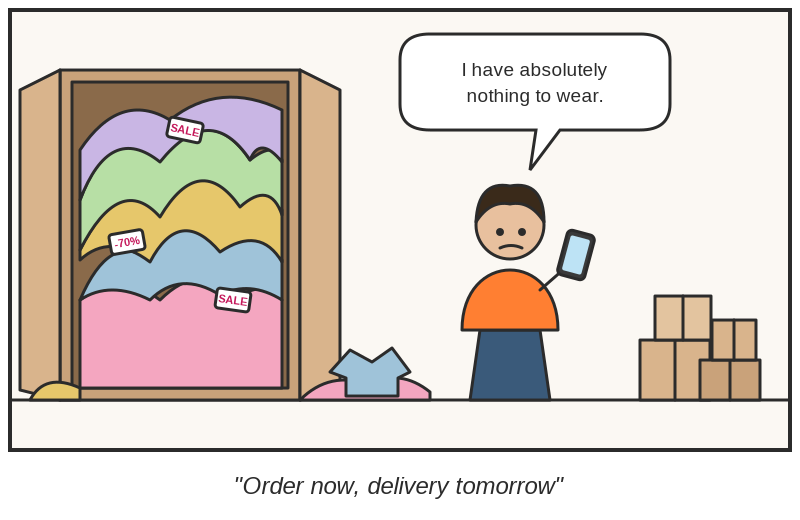
Description: The cartoon "Nothing to wear", which was drawn for this course, deals with buying too many clothes. On the left there is a wardrobe which is so full that its doors have burst open. Clothes with price tags saying "SALE" and "-70%" are falling out of it, and some are lying on the floor. In the middle a teenager is standing next to the wardrobe, holding a smartphone. In a speech bubble the teenager says, "I have absolutely nothing to wear." On the right, next to the teenager, there is a pile of parcels. The caption reads "Order now, delivery tomorrow".
Analysis: The cartoonist criticises the way many people buy clothes. The overflowing wardrobe is an exaggeration which shows that the teenager already owns far too much. The price tags are a symbol of cheap offers that tempt people to buy things they don't need. There is a strong contrast between the full wardrobe and the speech bubble "I have absolutely nothing to wear", which makes the statement ironic. The parcels and the smartphone show that the teenager is ordering even more online, and the caption sounds like an advertising slogan. The message is that cheap fashion and online shopping make people buy more and more clothes without ever being satisfied.
Example 2: A model comment
I largely agree with the cartoonist. Many young people buy new clothes very often because online shops make it easy and cheap. Shops send offers to our phones every day, and we can order with one click. You can see this in the many parcels that arrive at some homes every week.
Buying so much is also a problem for the environment. Producing clothes needs a lot of water and energy, and many items are hardly worn before they are thrown away.
On the other hand, the cartoon exaggerates. Not every teenager has a wardrobe full of unworn clothes, and many young people buy second-hand clothes or swap them with friends.
All in all, the cartoon is effective because the ironic speech bubble makes readers think about their own shopping habits.
Rule
Comment: take a clear position, support it with arguments and examples, mention the other side if it fits, and end with a conclusion. A complete cartoon task: describe, analyse, comment, each part in its own paragraphs.
Exercises
Grundlagen
- Which part of a cartoon task does each sentence belong to: description (D), analysis (A) or comment (C)? a) The parcels are piled up on the right. b) The price tags stand for cheap offers that tempt people to buy. c) I think the cartoon exaggerates, because many teenagers buy second-hand clothes. d) The teenager is holding a smartphone.
- Complete with your own ideas. a) I partly agree with the cartoonist because … b) On the other hand, …
Weiter
- Write a paragraph for the analysis of cartoon 3 about the caption "Order now, delivery tomorrow". Use point, evidence, explanation.
- Write a different comment on cartoon 3 (80 to 100 words) in which you disagree with the cartoonist.
Knobeln
- Complete cartoon task on cartoon 1 ("Family time"): Write a comment of 120 to 150 words. Do you agree that smartphones damage family life? Use arguments and examples.
- Compare cartoon 1 and cartoon 3. What do they have in common, both in their means and in their topic? Write 4 or 5 sentences.
Lösungen
- a) D b) A c) C d) D
- Individual answers, for example: a) … many people buy more clothes than they need. b) … some people only buy what they really need.
- For example: The caption "Order now, delivery tomorrow" is written like an advertising slogan (point). It appears below a picture of a wardrobe that is already full and a pile of parcels (evidence). This shows that the online shops encourage the teenager to keep buying, even though there is no need for more clothes (explanation).
- For example: I don't fully agree with the cartoonist. Of course some people buy too many clothes, but the cartoon makes young people look worse than they are. Many teenagers have little money and only buy new clothes when they need them. Second-hand apps and flea markets have become very popular, and many young people care about the environment. In my opinion, the cartoon should rather criticise the fashion companies that produce cheap clothes in huge amounts.
- Individual answers. Check: clear position, at least two arguments with examples, conclusion.
- For example: Both cartoons criticise how modern technology changes our behaviour. In both of them a smartphone plays an important role. Both use irony: the caption "Family time" and the sentence "I have absolutely nothing to wear" say the opposite of what we see. Both cartoons also exaggerate: the whole family is on the phone, and the wardrobe is bursting with clothes. They want readers to think about their own habits.