
Getting started
Why does the story work so well? Saki uses only about 1,200 words, but he builds tension, misleads the reader and ends with a laugh. In this lesson you look at the tools he uses: plot structure, narrator and point of view, setting and irony. These terms help you to analyse any short story.
Auf Deutsch: Hier lernst du die englischen Fachbegriffe für die Analyse: plot, narrator, point of view, setting, irony. Viele kennst du schon aus dem Deutschunterricht.
Explanation
Typical features of a short story
- short, can be read in one go,
- few characters and one main event,
- often an open beginning (we are dropped into a situation),
- a turning point or twist,
- often an ending that leaves room for thought.
The Open Window begins in the middle of a conversation and ends with a twist and a punchline.
Plot structure
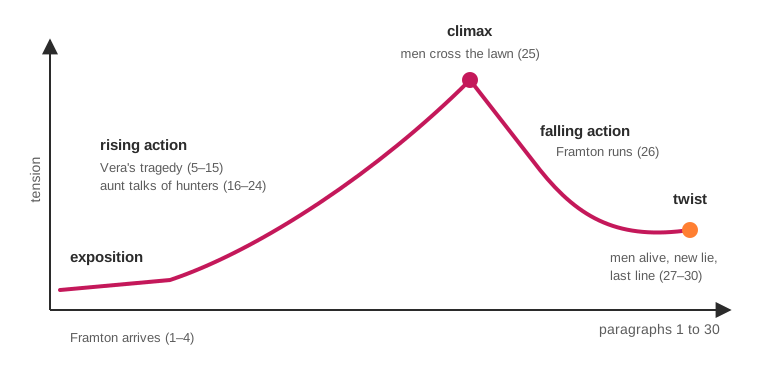
| part | in the story |
|---|---|
| exposition | Framton visits the house; we learn about his nerve cure (paragraphs 1 to 4) |
| rising action | Vera tells the tragedy; Mrs Sappleton talks about the hunters (paragraphs 5 to 24) |
| climax | the three men walk across the lawn (paragraph 25) |
| falling action | Framton runs away (paragraph 26) |
| resolution / twist | the men are alive; Vera invents a new story; Romance at short notice was her speciality (paragraphs 27 to 30) |
Narrator and point of view
The story is told by a third-person narrator. The narrator mostly follows Framton's point of view: we know what Framton thinks and feels (To Framton it was all purely horrible), but we never learn what Vera thinks. This is the key to the trick. At the same time, the narrator sometimes comments from outside with ironic, polite language, for example on Framton's "delusion" (paragraph 21) and in the last sentence. Because we see the events through Framton's eyes, we believe Vera's story as he does.
Auf Deutsch: Der Erzähler ist ein Er-Erzähler, der überwiegend aus Framtons Sicht erzählt. Er kommentiert aber auch von außen und ironisch, etwa Framtons „delusion“ (Absatz 21) oder den letzten Satz. Veras Gedanken bleiben verborgen. Deshalb fällt der Leser zusammen mit Framton auf die Lüge herein.
Setting
The story takes place in a quiet English country house around 1900, at dusk in October. The calm setting makes the "ghost" more frightening. Twilight helps too: the men appear as "three figures" in the "deepening twilight" (paragraph 25), just like ghosts in a story.
Irony and humour
- Dramatic irony: the reader knows more than a character. The reader, like Framton, has heard Vera's story, but Mrs Sappleton has not (lesson 2).
- Verbal irony: the narrator describes Framton's habit of talking about his illnesses as a "tolerably widespread delusion" (paragraph 21). The polite language makes fun of him.
- Situational irony: Framton came for rest and "an absence of mental excitement" (paragraph 21), and gets the biggest shock of his life.
Examples
Example 1: Analysing the point of view
The story is told by a third-person narrator who mainly presents Framton's thoughts and feelings, for example "To Framton it was all purely horrible" (paragraph 20). Vera's thoughts are never shown. As a result, the reader only knows what Framton knows and believes Vera's story too. This makes the twist at the end possible.
Example 2: Analysing the ending
The last sentence, "Romance at short notice was her speciality" (paragraph 30), is short and dry. After Vera's dramatic story about the Ganges, the calm comment of the narrator creates humour. It also explains the whole story in one line: the tragedy was invented. The reader now has to reread the beginning in a new light.
Rule
Analyse a short story with the terms plot (exposition, rising action, climax, falling action, resolution), narrator and point of view, setting and irony. Always say what a technique does: effect on the reader.
Exercises
Grundlagen
- Match the terms with the definitions: climax, setting, point of view, twist. a) the time and place of a story b) the moment of highest tension c) a surprising turn at the end d) the perspective from which a story is told
- Name two features of a short story that you find in The Open Window.
Weiter
- Explain the effect of the setting (country house, October, dusk) in three sentences.
- Find an example of verbal or situational irony that is not mentioned in the lesson. Explain it.
Knobeln
- Imagine the story were told by Vera as a first-person narrator. How would the effect change? Write 60 to 80 words.
Lösungen
- a) setting b) climax c) twist d) point of view
- For example: an open beginning in the middle of a conversation; few characters; one main event; a surprise ending.
- For example: The quiet country house makes a ghost story seem unlikely at first, so Framton's shock is even greater. October and the open window create an unusual detail that needs an explanation. The twilight makes the men look like ghostly "figures", which helps Vera's lie to work.
- For example: Mrs Sappleton calls Framton "a most extraordinary man" who "could only talk about his illnesses" (paragraph 28). This is ironic because the most extraordinary person in the house is her own niece. Another example: Framton's sister gives him letters so that his nerves get better, but one of them leads him into a terrible fright.
- For example: If Vera told the story, the reader would know from the beginning that the tragedy is invented. There would be no surprise ending. Instead, the reader would enjoy watching Framton fall for the trick. The story would be funnier but less suspenseful, and the reader would see Vera's cleverness from the inside.